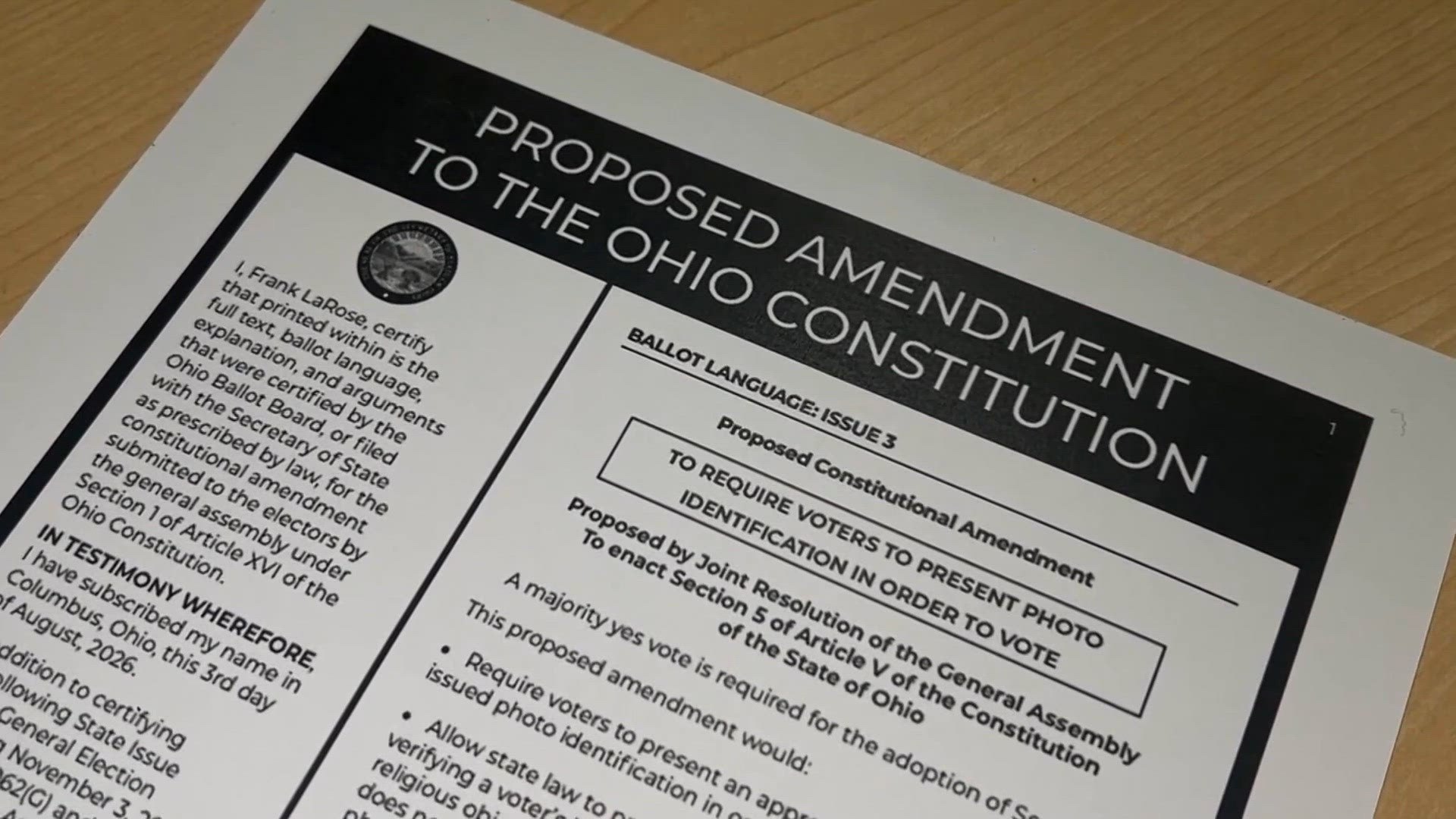
Ohio already requires a photo ID to vote. Issue 3 on the Nov. 3 ballot asks voters whether to write that requirement into the state constitution.
The difference matters. A law can be changed by the Ohio General Assembly in a single session. A constitutional amendment can only be changed by another statewide vote, according to the secretary of state's report on the measure.
The amendment was proposed by a three-fifths supermajority of the General Assembly through Substitute Senate Joint Resolution 10. If a majority of voters approve it Tuesday, Nov. 3, it takes effect immediately.
What the amendment requires
The amendment text defines "photo identification" as one of these unexpired, government-issued documents bearing the voter's name and photo: an Ohio driver's license or state ID card, a U.S. passport or passport card, or a U.S. military ID, Ohio National Guard ID or Department of Veterans Affairs ID card.
Voters with a sincere religious objection to being photographed could use an alternative verification method set by state law. Absentee voters could provide a signature and at least one other unique identifier if authorized by the legislature.
Ballot rejections climbed after 2023 law
A 3News Investigates analysis of provisional ballot data from every Ohio county found a sharp increase in rejections tied to identification after House Bill 458, the 2023 photo ID law, took effect.
Before H.B. 458, voters could present utility bills or bank statements to verify identity. Under the law, only government-issued photo IDs are accepted.
In the three general elections before H.B. 458 (November 2020, 2021 and 2022), 2,041 provisional ballots were rejected statewide for inadequate ID, 3News reported. That averaged about 680 per election. In the three elections after H.B. 458 (November 2023, 2024 and 2025), the total reached 12,117, averaging about 4,000 per election.
The 2024 presidential election alone saw 7,053 provisional ballots rejected for ID issues out of 5,851,387 total ballots cast, according to 3News.
In Cuyahoga County, 0.43 percent of mail and provisional ballots were rejected in the 2024 general election, according to a Union of Concerned Scientists analysis. Missing identification was the second most common reason, at 14.29 percent of rejections.
Supporters and opponents split on the data
State Sen. Jane Timken, a Canton Republican and co-sponsor of the amendment, told 3News the increase suggests the system is working. She said the numbers indicate some voters lacked adequate ID and that Ohio has "rare, but we do have instances" of voter fraud, according to 3News.
State Rep. Terrence Upchurch, a Cleveland Democrat, told 3News the jump reflects added restrictions. He said Ohio has "not experienced mass voter fraud," according to the investigation.
Digital IDs raise an open question
The amendment's language uses the words "card" and "document" repeatedly. Ohio launched digital driver's licenses in Google Wallet on Aug. 31, according to the Ohio Bureau of Motor Vehicles. Those digital IDs are accepted at TSA checkpoints and select venues statewide.
Whether a digital ID on a phone screen qualifies as a "card" or "document" under the amendment is an open legal question the text does not answer, 3News reported. The amendment's phrase "means one of the following" typically creates a closed list in legal interpretation, according to the investigation's legal analysis.
Supporters say the amendment's clause "in accordance with laws passed by the general assembly" gives the legislature room to address technology changes. Opponents counter that if the language creates confusion, fixing it would require another constitutional amendment and another statewide vote.
How to vote
Early in-person voting continues through Sunday, Nov. 1. Election Day polls are open 6:30 a.m. to 7:30 p.m. Tuesday, Nov. 3, according to Axios Cleveland. Absentee ballots must reach the county board of elections by 7:30 p.m. Nov. 3.